Brain Tumors - A Different Playing Field
We are in the middle of International Brain Tumor Awareness week and what better time to talk about brain tumors. I will preface this by saying that I'm a neurologist, not a neuro-oncologist, and this is meant to be a very general, bird's-eye view. There are plenty of resources out there which can delve into much further detail.
When faced with a new mass, no matter where in the body it is discovered, the first question usually is "is it benign or malignant?" What does this mean?
Benign implies a slow-growing group of cells, one that tends to behave nicely and stay where it originally started. Benign, in the usual vernacular, means something is "good." Malignant, on the other hand, suggests the tumor is more aggressive, plowing through nearby regions and (if bold enough and furnished with the resources it needs like ample vasculature to siphon nutrients and oxygen) can spread to other distant locations in the body. Malignant here is synonymous with "bad."
But do good and bad hold their meanings when they start their story in the skull (a.k.a. a primary brain tumor)? It's tricky.
First, you have a (generally) unyielding container--the skull--in which a tumor starts to grow. It's like trying to proof dough in a Dutch oven which is already full of jelly.
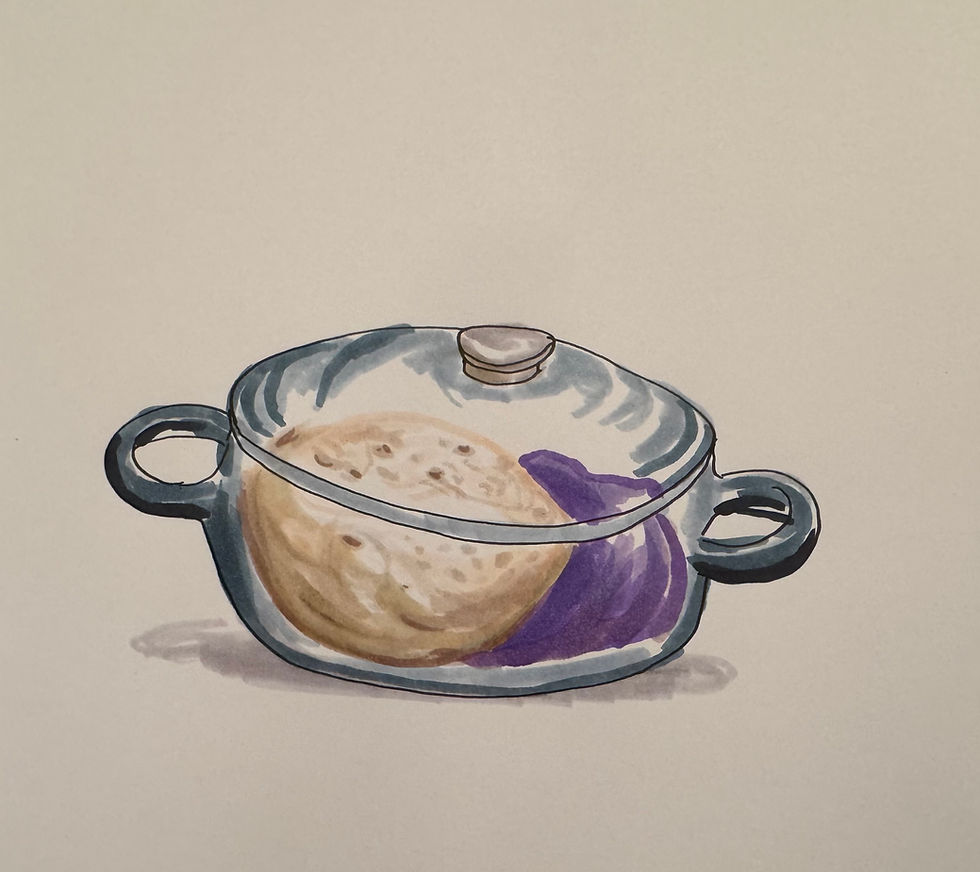
Benign or malignant, the limited space adds more complications in either case. Things are bound to get squished and compressed to make room for the growing mass. This increases pressure, and can underlie the appearance of symptoms like headaches and vomiting.
Then, there's the matter of it growing within the brain itself or sidling up next to it as it grows. When brain gets distorted, depending on which region, you can have a number of different effects. It doesn't matter how fast or slow a tumor grows. At a certain point, the brain reaches its limit for how much it can tolerate before showing signs that something is wrong. If it starts to affect regions involved with sensation, perhaps you might notice numbness or burning in an arm, a leg, maybe one whole side of your body. If the region controls movement, a growing tumor might cause weakness and changes in coordination or dexterity.
On one end of the spectrum, you can have so-called "benign" tumors like meningiomas (arising from the layers which cover the brain), which often plod along growing at a snail's pace until the brain is compressed enough to start sounding alarms. On the other end, you can have a malignant tumor like a glioblastoma (GBM)--which is my husband's tumor--prone to unhinged, chaotic growth, and with a knack for returning like a nightmarish game of whack-a-mole. Metastatic brain tumors would be inherently malignant, given that they themselves spread from another, often distant primary tumor elsewhere in the body.
Benign in the brain does not mean it will not have a negative effect. It often does, which is how it is brought to attention. It just might do so more slowly.
There is unfortunately no preventive screening for brain tumors in the way that there is for breast cancer and colon cancer. While usually symptoms like worsening headaches (particularly with "red flag" signs) or new neurologic signs such as the weakness or sensory changes described above are what cause the tumor to be discovered, sometimes they are incidentally discovered. Think of an individual who may have been in a car accident in which they were a restrained passenger. In the ER, they get head imaging, and suddenly find themselves facing a plot twist they did not likely expect.
Treatments depend very much on the tumor. Sometimes, watching and getting yearly MRIs might be the best plan of action. Sometimes surgery is enough to be curative. Sometimes, a round of chemotherapy or radiation may suffice. Sometimes, more might be needed. I touch on the treatment for GBM here (along with more specific information about gliomas and GBM).
I wanted to give a very broad overview of a set of tumors that themselves have their own backstories and unique features, each one warranting their own lecture if not their own course or courses. There are many good resources for the general public to learn more about different types of tumors, I'll share a few links below (some of which I have shared elsewhere).
Johns Hopkins: https://www.hopkinsmedicine.org/health/conditions-and-diseases/brain-tumor/brain-tumor-types
National Brain Tumor Society - Brain Tumor Facts: https://braintumor.org/brain-tumors/about-brain-tumors/brain-tumor-facts/
American Brain Tumor Association - Brain Tumor Types: https://www.abta.org/about-brain-tumors/brain-tumor-types/
Comments